Academic integrity in the age of AI writing
Over the years, technology has supported and tested academic integrity. Today, educators and students face a new frontier with AI-generated text and ChatGPT.
We believe that AI models can be positive forces that, when used responsibly, can support and enhance the learning process. We also believe that equitable access to AI tools is vital. We’re working with educators and students to develop technology that can support and enhance the learning process. However, it’s important to acknowledge new challenges alongside the opportunities.
We recognize that educators need to know when and where students have likely used AI writing tools. That’s why we now offer an AI content detector and more capabilities for educators in our products.
Gain valuable insights into student submissions
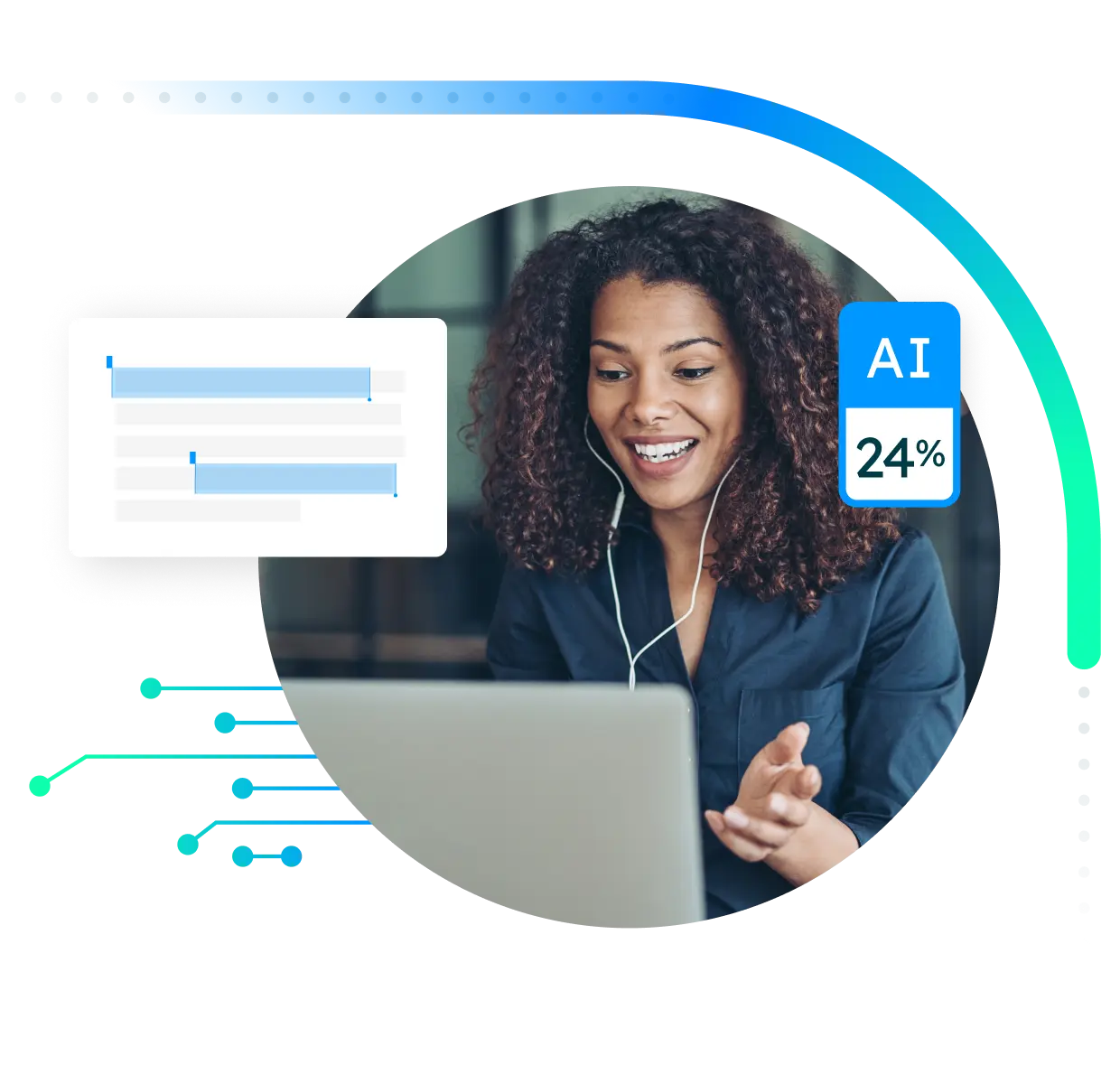
Our AI checker provides valuable insights on how much of a student’s submission is authentic, human-written content versus likely AI-generated from ChatGPT including likely AI-paraphrased or bypassed content.
Detect AI content with powerful reporting
Reporting identifies likely AI-written or AI-modified content, providing the information educators need to determine their next course of action. We’ve designed our AI essay checker with educators, for educators.
Check student essays as you do today
Our AI essay detector complements our similarity checking workflow and is integrated with your LMS, providing a seamless, familiar experience.
Research corner
Check out the links below if you’re interested in the additional research we performed against English Language Learners and what an independent research study has revealed about Turnitin's AI-writing detection capabilities.
Research shows our AI scanner shows no statistically significant bias against English Language Learners
- In response to customer feedback and papers claiming that AI detector tools are biased against writers whose first language is not English, we expanded our false positive evaluation to include writing samples of English Language Learners (ELL). We tested another nearly 2,000 writing samples of ELL writers.
- We found that in documents meeting the 300-word count requirement, ELL writers received a 0.014 false positive rate, and native English writers received a 0.013.
- This means that there is no statistically significant bias against non-native English speakers.
Independent research shows the “Turnitin [AI writing detector] achieved very high accuracy”
- Two of the 16 detectors, Turnitin and Copyleaks, correctly identified the AI- or human-generated status of all 126 documents, with no incorrect or uncertain responses.
- Three AI text detectors — Turnitin, Originality, and Copyleaks — have very high accuracy with all three sets of documents examined for this study: GPT-3.5 papers, GPT-4 papers, and human-generated papers.
- Of the top three detectors identified in this investigation, Turnitin “achieved very high accuracy” in all five previous evaluations. Copyleaks, included in four earlier analyses, performed well in three of them.